
For an ordinary cardholder, choosing a card often comes down to annual fees, rewards, and ATM costs. Web3 professionals have an extra layer of complexity: income may first arrive as USDT, USDC, ETH, or project tokens in an exchange account or onchain wallet, and those assets still need to connect to the bank-card payment network before they can be spent.
Before choosing a card, map out your money flow: which chain your income arrives on, which assets the card accepts, whether deposits are automatically converted into U.S. dollars, and whether another conversion fee is charged when you spend. If you regularly pay for cloud services, domains, AI tools, or advertising accounts, you also need to check recurring-payment support and 3DS. Team spending is a different problem entirely: a personal card cannot replace member limits, approvals, and corporate billing.
My rule is simple: first look at where the money comes from, then where it is mainly spent. Cashback and card tiers come last.
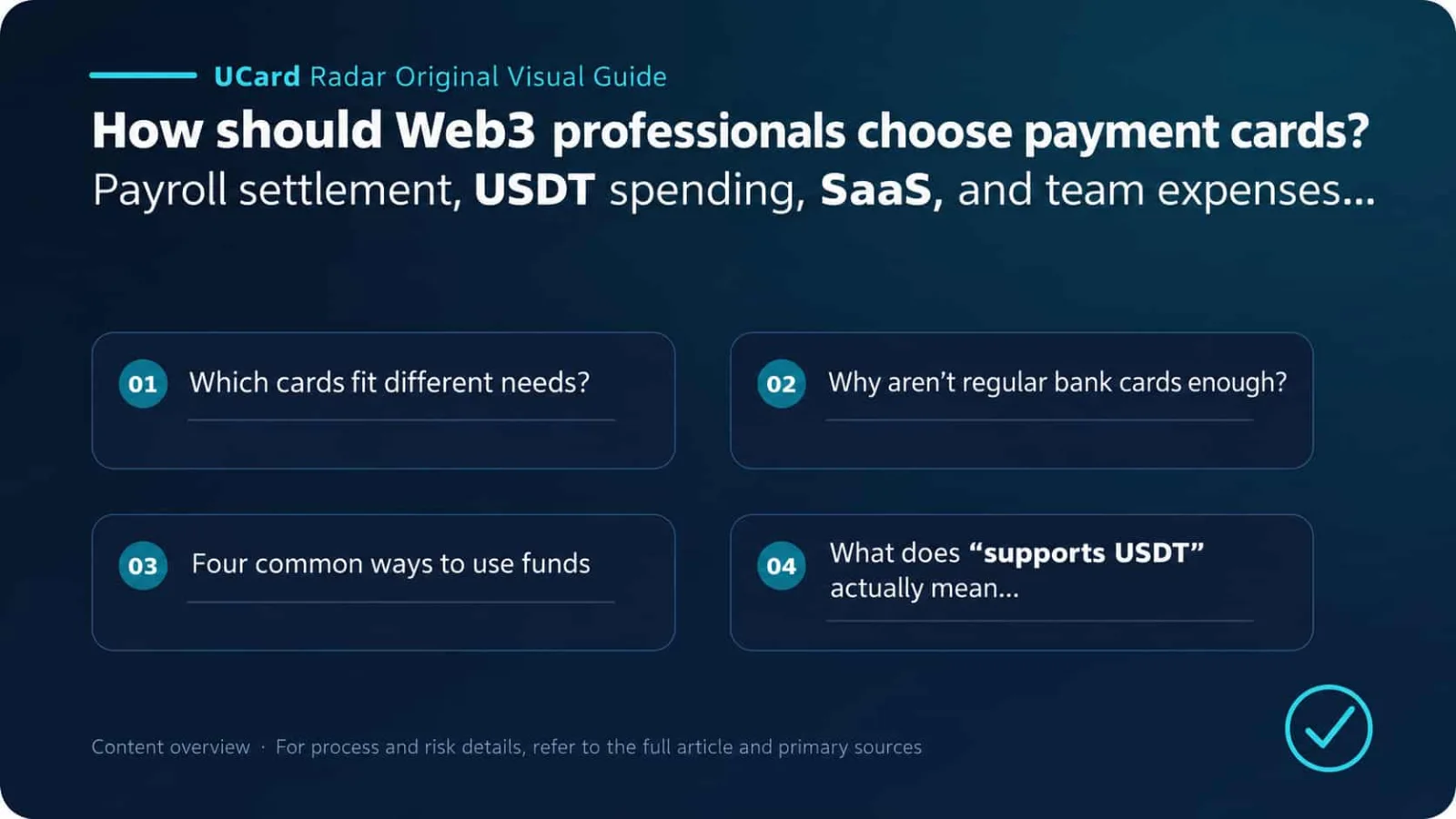
Sources and Scope of Conclusions
Primary verification sources: Visa and Bridge Partner to Make Stablecoins Accessible for Everyday Purchases; Rain and Visa partner to accelerate onchain credit cards; Gnosis Pay Card.
The verifiable statements in this article regarding Web3 card issuance, stablecoin settlement, and network acceptance are based on the cited official or regulatory materials. Actual service status, fees, eligibility, and geographic availability should be confirmed on the issuer’s or platform’s page at the time of application.
Results may vary by issuer, region, account tier, and merchant rules. Experiences, success rates, fee comparisons, or trend assessments not directly disclosed in the primary sources above should be treated as analysis or inference and have not been officially confirmed for individual cases by the relevant institutions.
Which Cards Fit Different Needs?
Use Case | Cards to Consider | Main Reason | What to Watch |
|---|---|---|---|
Receiving salary in USDT or USDC | KAST, Bybit Card, RedotPay | Easy funding and direct access to spending cards | Still personal accounts; not suitable for shared use |
Receiving funds across multiple chains | KAST | Supports stablecoin deposits across Ethereum, Solana, Tron, Arbitrum, Polygon, Base, and others | Automatic conversion of non-stablecoins can incur fees |
Assets already held on an exchange | Can spend directly from Funding Account balances | Crypto spending usually involves conversion fees | |
Want to retain self-custody | Funds can remain in onchain wallets until spending | Supported regions and asset ranges are limited | |
Paying for SaaS, AI tools, and domains | KAST, Bybit Card, MetaMask Card | Fast virtual-card setup and support for online and recurring payments | Merchants may still reject prepaid or virtual cards |
Separate cards for team members | Member cards, spending limits, merchant restrictions, and approvals | Requires a company entity and KYB | |
DAO or project-team expense management | Connects stablecoins to corporate expense systems | Anonymous wallets cannot directly open accounts | |
Small team without a company entity | Personal cards can only serve as a temporary workaround | Quick to obtain | Card numbers should not be shared; reimbursement and auditing are difficult |
One distinction needs to be clear. KAST, Bybit, MetaMask Card, and Gnosis Pay are payment cards held in an individual’s name. They can be used to pay for servers or project subscriptions, but they do not provide member management, corporate billing, approvals, or accounting permissions. Once spending involves multiple people, corporate-card systems such as Reap or Rain are a better fit.
Why Are Ordinary Bank Cards Not Enough?
Traditional bank cards assume a path of “income into a bank account → spending through a bank card.” Web3 professionals more commonly have a flow like this:
Project or client payment
→ Onchain wallet or exchange
→ Stablecoins or other tokens
→ Payment-card balance
→ SaaS, advertising, travel, and everyday spending
Without a crypto payment card, users usually have to sell USDT first, withdraw fiat to a bank account, wait for the transfer to settle, and only then spend with a card. Cross-border teams may also face bank reviews, receiving-country restrictions, and longer processing times.
Crypto payment cards remove some of those steps, but they are not free. A single purchase can involve network fees, deposit fees, conversion fees, FX fees, and withdrawal fees. “Zero deposit fee” only means the entry point is free; it does not mean the final cost is low.
Four Common Ways to Use Funds
1. Spend Directly From an Exchange Balance
Bybit Card falls into this category. Once salary or project income reaches a Bybit Funding Account, fiat balances can be debited directly. If the account contains only crypto assets such as USDT, the platform converts them when the payment is made.
The route is convenient, but the trade-off is that funds remain on the exchange, and spending crypto can generate conversion fees. Bybit currently charges roughly 0.9% in crypto conversion fees across several card programs. FX fees and limits depend on the issuing region; for example, the Australian program charges a 1% FX fee, while Brazil charges 1.5%.
If you already receive payments or trade through Bybit, mainly use USDT, and are comfortable keeping part of your day-to-day funds on a centralized platform, this route can eliminate one onchain transfer.
2. Convert Stablecoins Into a USD Balance First
When KAST receives a supported stablecoin, the account displays a corresponding U.S. dollar balance, which can then be spent through the Visa card. The platform currently does not charge deposit fees for supported stablecoins, converts them into a USD balance at 1:1, and does not apply a spread.
KAST supports a relatively broad range of funding networks:
USDT: Ethereum, Solana, Tron, Polygon, BNB Chain, Arbitrum, Avalanche, TON;
USDC: Ethereum, Solana, Polygon, Base, Stellar, Arbitrum, Avalanche, Optimism, Sonic;
PYUSD: Ethereum, Solana;
RLUSD: Ethereum, XRPL.
Non-stablecoins such as BTC, ETH, SOL, XRP, and BNB can also be deposited, but they are automatically converted. KAST’s latest fee page shows that these conversions generally cost 2% to 5%. If your income arrives in ETH or project tokens, it is often cheaper to convert them into USDT or USDC on a liquid exchange or DEX first, then deposit over a lower-cost network.
3. Connect a Self-Custody Wallet to a Payment Card
MetaMask Card and Gnosis Pay take a different approach: funds remain in an onchain wallet or smart account until the moment of payment.
MetaMask Card lets users specify which wallet, tokens, and spending limits the card can use. The assets are converted to fiat only when the purchase occurs. Current support includes:
Network | Supported Assets |
|---|---|
Linea | mUSD, USDC, USDT, wETH, EURe, GBPe |
Solana | USDC, USDT |
Base | USDC, USDT |
Monad | USDC |
Users in New York and Texas can currently use only Linea and Base, not Solana or Monad.
The free tier has a USD 10,000 per-transaction limit and USD 15,000 daily limit; the metal-card tier allows USD 20,000 per transaction and USD 30,000 per day. Local-denominated stablecoins generally do not incur conversion fees, cross-border transactions on the free tier incur 1%, and non-stablecoins such as wETH incur a 0.875% conversion fee plus a small amount of onchain Gas.
Gnosis Pay uses a Safe smart account. EURe, GBPe, or USDCe remain in the user’s own Gnosis Pay Safe and connect to the Visa network only when a card transaction is made.
Key current rules include: no transaction fee for everyday card spending; stablecoins are debited 1:1; the platform does not add a separate FX fee and uses Visa’s exchange rate; the per-transaction spending limit is 5,000 and the rolling 24-hour limit is 8,000; the first five ATM withdrawals each month or the first 200 in value are free, after which a 2% fee applies.
One important limitation is that Gnosis Pay explicitly positions the product as a personal card and does not support business use. Using it long term for company expenses may breach product rules or result in declined transactions.
4. Connect a Stablecoin Business Account to Team Cards
Reap Card and Rain Corporate Cards are built for companies. A business first places USDT, USDC, or fiat into an expense-management system, then issues cards to team members, projects, or suppliers.
Reap offers USD- or HKD-denominated Visa corporate credit cards. A company can use USDC, USDT, or fiat as collateral, receive a 1:1 credit line, and settle monthly in stablecoins or fiat. The platform supports an unlimited number of virtual and physical cards, with budgets by member, project, campaign, or time period, plus merchant-category, geographic, and time-based restrictions.
Rain likewise supports fast creation of physical and virtual cards, spending limits, merchant-category controls, approval flows, and integrations with accounting tools such as QuickBooks and Entendre. Rain states that its corporate cards can settle against stablecoin balances and perform daily onchain reconciliation.
These solutions are suitable for already incorporated projects where multiple employees or contractors need to spend, advertising, cloud services, travel, and procurement require separate controls, and invoices, receipts, and accounting records must be retained.
What Does “Supports USDT” Actually Mean?
Two cards can both say they support USDT while handling funds very differently behind the scenes.
KAST displays incoming USDT or USDC as a 1:1 USD balance. The merchant receives fiat settled through the card network, not USDT.
Bybit Card selects assets from the Funding Account and converts them when payment occurs. If neither the account asset nor the merchant’s billing currency matches the card’s base currency, both crypto conversion fees and FX fees can apply.
MetaMask Card and Gnosis Pay keep assets in wallets or smart accounts and complete authorization, conversion, and settlement only when the card is used.
Reap lets businesses post USDC, USDT, or fiat as collateral and receive a credit line. It does not sell onchain assets in real time for every card swipe.
So when you see “supported assets,” keep asking: which networks can I deposit from? Does the asset still exist after funding? When does the platform convert it into USD? At what price? If a purchase is refunded, does the refund return as USD balance or the original asset?
How Do Fees Stack Up?
The cost of a Web3 card mainly comes from onchain transfers, platform deposits or conversions, crypto conversion at the time of purchase, FX, and cash-out or withdrawal fees.
Onchain Network Fees
Funding from a wallet generally requires Gas. Solana, Base, Arbitrum, and Polygon are usually better suited to frequent small transfers, while Ethereum mainnet can become expensive when congested. Fees change with network conditions, so no single number remains valid for long.
Do not merely confirm that a card supports USDT. Check whether it accepts TRC-20, ERC-20, Solana, or another network. Choosing the wrong network can create extra routing work at best and lead to lost funds at worst.
Deposits and Automatic Conversion
KAST does not charge a deposit fee for supported stablecoins. Automatic conversion of non-stablecoins costs 2% to 5%.
RedotPay can receive USDT, USDC, BTC, ETH, BNB, SOL, TRX, XRP, and other assets. Each asset must be sent through a network specified in the app and is subject to a minimum deposit amount. Networks and minimums can change, so the deposit page should be checked before transferring.
Conversion Fees at the Point of Purchase
Bybit charges 0.9% on crypto-funded payments in some regions. For example, if you pay EUR 100 while the account holds only USDT, the platform first calculates the required USDT using its current one-click sell price, then adds the conversion fee. The real cost cannot be estimated solely from the nominal EUR 100 purchase amount.
MetaMask Card generally does not charge a conversion fee when USDC, USDT, or other stablecoins are used for locally denominated purchases. Payments funded with assets such as wETH incur a 0.875% conversion fee plus onchain Gas.
FX Fees
If the card’s base currency differs from the merchant’s billing currency, an FX fee may be added.
When KAST is used to withdraw non-USD cash from an ATM, it may charge an FX fee of 0.5% to 1.75% in addition to USD 3 plus 2% of the withdrawn amount.
Bybit FX fees vary by region: Australia 1%, Brazil 1.5%, Argentina 7%, with other programs using different rules. A card can therefore be very economical for subscribing to U.S. SaaS but less attractive for long-term local-currency spending in another country.
Transfers Out and ATM
KAST currently charges USD 1 plus 0.1% to send USDT or USDC via Solana; USD 0.20 plus 0.1% for USDC via Arbitrum; USD 6 plus 0.1% via Ethereum; and USD 5 plus 0.1% for Tron USDT.
KAST charges USD 3 plus 2% for ATM withdrawals, with a maximum of USD 250 per withdrawal and up to three withdrawals or USD 750 within 24 hours. Gnosis Pay makes the first five ATM withdrawals each month or the first 200 in value free, then charges 2%.
ATMs are useful for occasional cash needs, not for moving large income amounts. For larger sums, compliant exchanges, bank transfers, or corporate payment channels are usually more reliable.
What Matters When Paying for SaaS, Cloud Services, Domains, and Advertising?
Common business bills for Web3 professionals include AWS, Google Cloud, Cloudflare, Vercel, GitHub, Notion, ChatGPT, Claude, Cursor, domain names, ad platforms, and design software. A card that works for one-off online shopping is not necessarily reliable for recurring subscriptions.
Recurring Payments
SaaS providers store the card and automatically renew it. When choosing a card, check whether recurring payments are supported, whether the card number changes frequently, how retries work after insufficient balance, whether 3DS verification can be completed, and whether refunds can still arrive after a card is frozen.
Bybit has listed ChatGPT Plus and Claude Pro among its official subscription-reward merchants. KAST also lists software subscriptions as a business-spending use case for freelancers and provides expense categorization.
Preauthorizations and Balance Buffer
Cloud platforms, hotels, rental cars, and ad accounts may place a hold first and settle the actual charge later. If you keep only the exact expected invoice amount on the card, taxes, exchange rates, preauthorizations, or usage overruns can easily cause a decline.
Cards used for AWS, advertising, or AI APIs should ideally maintain a balance slightly above the expected invoice and have separate alerts configured.
Advertising Accounts Are Better on Separate Cards
Ad platforms charge frequently, and the amount changes with campaign spend. When all business activity uses one card, an issue on one ad account can affect unrelated subscriptions. A sudden increase in ad spend can also consume funds reserved for server or software renewals.
A safer structure is to use one card each for advertising, cloud services, and ordinary team expenses, with different limits on each card. Reap can set rules by project, member, merchant type, region, and time. Rain also provides member cards, approvals, category restrictions, and accounting integrations, making it better suited to teams with finance staff.
Personal Cards, Business Cards, and Team Expense Cards
Item | Personal Card | Business Card | Team Expense Card |
|---|---|---|---|
Account holder | Individual | Company | Company |
Verification | KYC | KYB + related-person KYC | KYB + member information |
Number of cards | Usually one or a small number | Multiple cards possible | Created by member and use |
Can it be shared? | Should not be shared | Employees can be authorized | Issued specifically to members |
Limit controls | Personal daily limit | Company-wide limit | Separate controls by member, project, and merchant |
Billing ownership | Individual | Company | Consolidated company billing |
Receipt management | Limited | Usually supported | Usually supported |
Accounting export | Not always available | Generally available | Core feature |
Employee departure | Replace or freeze card | Remove member permissions | Disable member card immediately |
Best use | Salary and personal subscriptions | Founder business spending | Multi-person team operations |
The most common mistake is giving one personal card number to several team members.
KAST’s personal-card terms require the card to be used only by the cardholder and prohibit use by other people or for expenses not incurred by the cardholder. Gnosis Pay likewise states that the card is for personal use and does not support business use.
If development, marketing, and travel are handled by three different people, the company should create three separate company cards rather than share one personal virtual card.
KYC, Proof of Funds, and Freeze Risk
Crypto cards are not anonymous cards. Individual applicants usually need an identity document or passport, facial verification, residential address, phone number, email, and tax or nationality information. For higher-risk activity or larger funding amounts, the platform may also request an explanation of the source of funds.
Business onboarding requires KYB. Reap requires all Reap Direct and Reap Card business accounts to complete KYB, verifying the company entity and the individuals behind it. Common documents include certificates of incorporation, business registration documents, articles of association, and identity and address documents for directors and shareholders. Additional requirements vary by jurisdiction, company type, and risk profile.
For onchain income, it is best to retain these records in advance:
Employment contracts, consulting agreements, or client invoices;
Project-payment explanations, salary records, or commission records;
Proof of wallet ownership and onchain transaction hashes;
Exchange withdrawal records;
Token-unlock or reward documentation;
Filed tax documents.
If a large USDT payment arrives from an unfamiliar address and is quickly deposited into a card account and spent, the platform cannot easily determine from the blockchain alone whether it represents salary, project revenue, or funds collected on behalf of someone else. Contracts, invoices, and transfer records make the flow easier to explain.
Receiving money on behalf of others, using mixers or high-risk addresses, accepting unexplained OTC funds, moving large amounts in and out within a short period, sharing an account among multiple users, or repeatedly retrying failed payments can all increase the risk of review or account freezing. RedotPay also warns that repeated card-linking or payment attempts within a short period can trigger a security freeze.
How Should Backup Cards and Funds Be Layered?
Do not make one card responsible for salary, savings, SaaS, and team spending at the same time. Funds can be separated into four layers.
Layer One: Long-Term Funds
Savings, investments, and project treasuries should not all sit in payment-card accounts. Individuals can use hardware wallets or other secure wallets; teams are better suited to multisig setups with clearly defined approval rules.
Layer Two: Operating Funds
Set aside one to two months of server, software, advertising, and team expenses. This portion can be held in less volatile assets such as USDC or USDT in a location that can quickly top up card balances.
Layer Three: Card Balances
Keep only near-term spending money on cards. Use separate cards for servers and domains, AI tools, and advertising so that if one card is frozen, the other services can still renew.
Layer Four: Backup Channels
Backup cards should ideally come from different issuers or card programs. If two cards share the same issuer, both may fail at once when there is a BIN restriction, regional-policy change, or issuer outage.
Backup channels can also include traditional bank cards, corporate bank accounts, App Store or Google Play subscriptions, merchant bank transfers, and approved employee reimbursement processes.
Which Cards Should Individual Web3 Professionals Focus On?
Frequently Receive USDT or USDC: KAST
KAST supports many stablecoin networks. USDT and USDC deposits carry no platform deposit fee and are converted into a USD balance at 1:1. It also supports USD receiving, card spending, and stablecoin withdrawals, making it suitable for freelancers with diversified income sources.
When using it, try to fund with stablecoins rather than relying on automatic conversion of non-stablecoins. Compare network fees before transferring out. ATM costs are relatively high and make it a poor primary cash-out route. Personal cards should also not be shared with team members.
Salary Already Comes Into Bybit: Bybit Card
These users can eliminate one onchain transfer. Bybit Card is suitable for people whose main income is USDT, who already trade on Bybit, and who are comfortable with roughly a 0.9% crypto conversion fee.
FX fees and limits vary substantially by program. The Asia-Pacific card program has a USD 10,000 per-transaction and daily limit and USD 50,000 monthly limit; the Australian program has a USD 13,500 per-transaction and daily limit. Before applying, confirm which program you will actually receive.
Want to Keep Self-Custody: MetaMask Card
MetaMask Card suits existing MetaMask users who want funds to remain in their wallet until payment. It supports selected stablecoins on Linea, Base, Solana, and Monad. The free card has a USD 15,000 daily spending limit, and users can define which accounts and limits the card can access.
The main restrictions involve application regions, supported assets, and fees. Non-stablecoins incur additional conversion costs, cross-border transactions may incur 1%, and users must correctly authorize the relevant token and wallet account before spending.
Primarily Hold Stablecoins: Gnosis Pay
Gnosis Pay charges no transaction fee for everyday card spending, with a 5,000 per-transaction limit and 8,000 daily limit. It is suitable for individual lifestyle spending and subscriptions. It is not suitable as a corporate card for a project team, and some merchant categories such as car rentals, unattended fuel pumps, and gambling are restricted.
Want Simple Card Issuance and a Backup Route: RedotPay
RedotPay supports USDT, USDC, BTC, ETH, BNB, SOL, TRX, XRP, and other assets, offers virtual and physical cards, and serves more than 100 countries.
It works well for personal spending or as a backup. Because some information on its public fee pages is displayed dynamically through images or the app, applicants should re-check current fees, supported networks, and limits before applying. It does not provide corporate member cards, budget approvals, or accounting exports, so it cannot replace a team expense-management system.
What Should Teams and Project Companies Choose?
Reap Card: Teams That Need Full Expense Management
Reap combines USDC and USDT funds, corporate credit cards, and expense management in one system. Companies can issue separate cards to multiple members, allocate separate budgets for advertising, cloud services, and travel, restrict merchants and regions, upload receipts, and repay bills in stablecoins.
The platform supports an unlimited number of virtual and physical cards, with budgets by day, month, year, member, project, and campaign. Businesses using USDT, USDC, or fiat can obtain a 1:1 credit line.
Opening an account is more complex than applying for a personal card. It requires KYB, corporate documents, and related-person verification, while pricing usually depends on the company’s circumstances.
Rain Corporate Cards: Global Teams With Existing Finance Processes
Rain is closer to stablecoin-based corporate payment infrastructure. It provides physical and virtual cards, member and category limits, approvals, stablecoin settlement, daily onchain reconciliation, and QuickBooks and Entendre integrations.
If the team already has operations, finance, and compliance processes, these functions are more useful than merely issuing more virtual cards. Pricing is negotiated under enterprise plans.
KAST Business: Clear Product Direction, but Still Waiting for Availability
KAST has presented a Business product intended to provide global corporate accounts, team payments, expense management, and payment capabilities across more than 170 countries. The current page still focuses mainly on applications and a waitlist, so the personal KAST card should not be treated as an enterprise product.
Freelancers can use personal KAST cards to manage their own business expenses. Multi-person teams are currently better served by providers such as Reap or Rain, which already offer corporate card-management features.
Teams should first determine whether they have a legal company entity. Without one, a personal card can only temporarily cover a founder’s expenses and cannot solve member permissions, reimbursement, or auditing. Once servers, advertising, travel, and team purchasing become recurring expenses, it is time to consider corporate-card systems such as Reap or Rain.
When choosing a card, I check six things: whether the source of onchain income can be explained, whether the funding network matches, whether conversion costs can be calculated clearly, whether recurring subscriptions can be charged reliably, whether team permissions are separated, and whether there is a backup route if the primary card fails.
On our platform, start with UCardRadar’s “Web3 Professionals” scenario. You can continue filtering by “Personal Spending,” “Business Subscriptions,” “Team Expenses,” and “Onchain Asset Funding,” then compare networks, fees, limits, and KYC requirements.