
For many people applying for a crypto card, the most practical use case is not in-store spending. It is paying for overseas tools such as ChatGPT Plus, Claude Pro, Midjourney and Cursor.
The problem is that a card showing a Visa or Mastercard logo does not mean it will definitely work. One user may successfully subscribe to ChatGPT with a card while another account using the same card is declined. A payment may also work in the first month and then suddenly fail when the subscription renews.
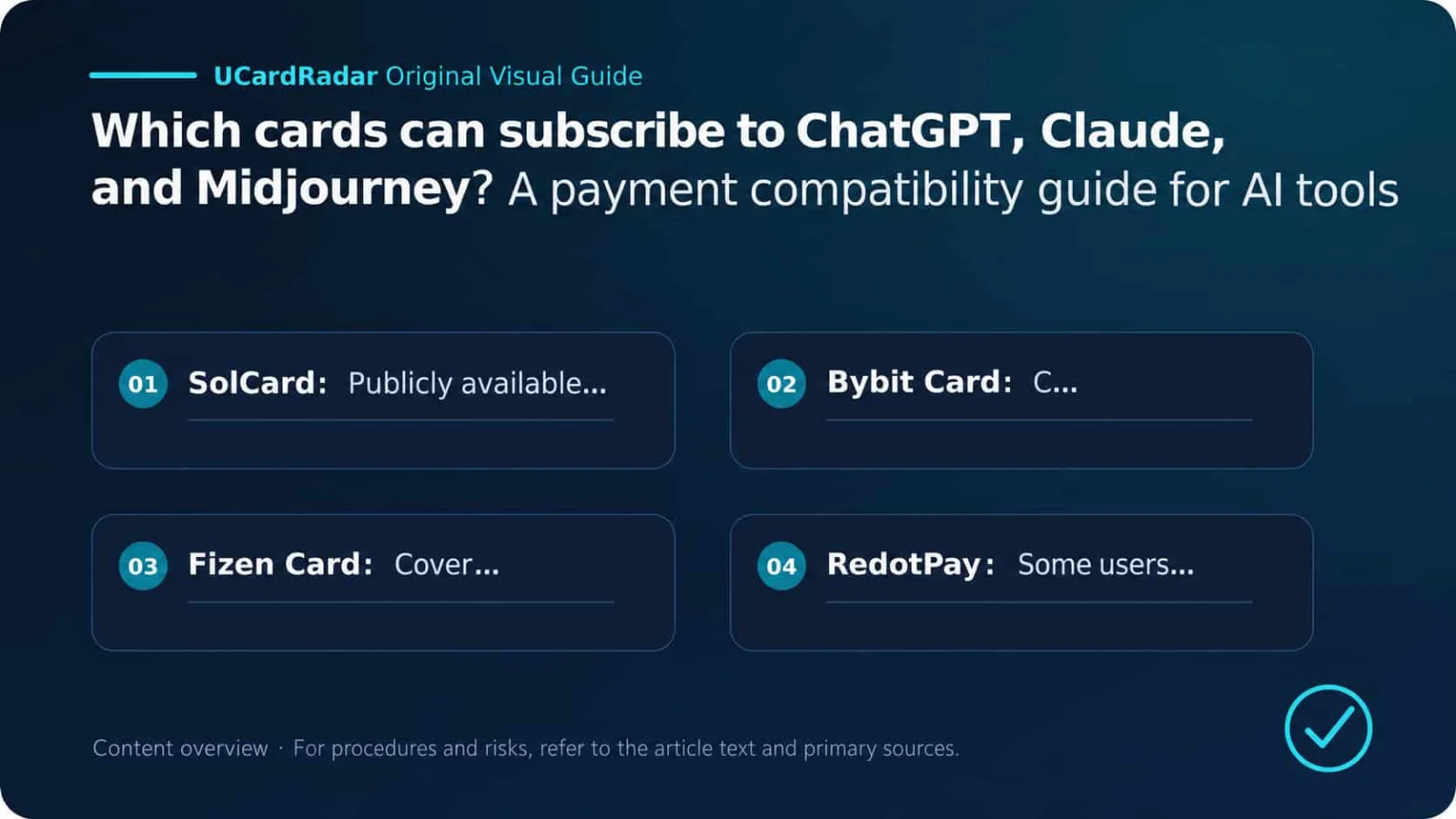
Based on the public information currently available, five cards are especially worth watching:
SolCard: covers the widest range of AI platforms and publishes transaction data for merchants such as OpenAI, Anthropic and Cursor;
Bybit Card: its official rewards program explicitly lists ChatGPT Plus and Claude Pro;
Kast Standard Card: an official KAST campaign directly required participants to pay for ChatGPT or Claude with a KAST card;
Fizen Card: officially claims support for ChatGPT, Claude, Midjourney, Cursor and Perplexity;
RedotPay Card: there are successful cases as well as recent failure reports, so its consistency is still difficult to judge.
First, the conclusion.
Card | ChatGPT | Claude | Midjourney | Public evidence | Current assessment |
|---|---|---|---|---|---|
Transaction data available | Transaction data available | Repeat-purchase data available | Card provider’s self-reported real transactions | Worth prioritizing for all three platforms | |
Official rewards merchant | Official rewards merchant | No equivalent evidence yet | Official Bybit campaign rules | Better fit for ChatGPT and Claude | |
Supported by official campaign | Supported by official campaign | No dedicated record yet | KAST official campaign and case study | Better fit for ChatGPT and Claude | |
Officially claimed support | Officially claimed support | Officially claimed support | Official Fizen article | Broad coverage, but no public sample size | |
Mixed success and failure reports | Failure reports exist | Insufficient data | Individual user cases | Existing cardholders can test it; not worth applying solely for this purpose |
“Supported” here does not mean permanently guaranteed.
AI platforms may check the issuing country, billing address, card type, 3DS support, account region and recurring-payment capability. Even cards under the same brand may have different BINs and issuers depending on the user’s country, so results can naturally differ.
Data and Conclusion Boundaries
Primary-source verification: ChatGPT supported countries; Which payment methods are supported for ChatGPT?; Why was my card declined?.
Verifiable facts in this article concerning regional availability, payment methods and payment-failure boundaries for AI subscriptions are based on the listed official or regulatory documents. Actual service status, pricing, eligibility and geographic availability should be confirmed from the card issuer or platform page at the time of application.
Different issuers, regions, account tiers and merchant rules can produce different outcomes. Experiences, success rates, fee comparisons and trend assessments not directly disclosed in the primary sources above are analysis or inference and have not been officially confirmed by the relevant institutions for individual cases.
SolCard: The Most Complete Public Record So Far
Among these cards, SolCard provides the most detailed public information specifically for AI-tool payments.
Its merchant directory already covers ChatGPT, Claude, Midjourney, Cursor, Perplexity, Notion, OpenRouter, ElevenLabs and other tools. SolCard says that payments still go through each merchant’s existing card checkout process, while the funds loaded onto the card come from crypto assets such as SOL, USDC and USDT.
As of this review, the data published on SolCard includes:
11,818 successful transactions at OpenAI merchants;
11,763 successful transactions at Anthropic merchants;
9,158 successful transactions at Cursor merchants;
41% of Midjourney users made another purchase;
40% of Perplexity users made another purchase;
63% of Notion users made another purchase.
The value of these figures is that they are not a vague claim such as “accepted at Visa merchants worldwide.” They map directly to specific AI platforms.
However, the source of the data matters. The figures are published by SolCard itself. There is currently no third-party audit, nor are total payment attempts for each platform disclosed. 11,818 successful transactions does not mean a 100% success rate because we do not know how many attempts failed during the same period.
A more accurate assessment of SolCard is therefore:
The provider reports a relatively large transaction sample across ChatGPT, Claude, Midjourney, Cursor and other platforms, but success rates and regional differences still require more independent verification.
What SolCard Can Pay For
Platform | Eligible uses disclosed by SolCard |
|---|---|
ChatGPT | Plus, Pro and Business renewals |
OpenAI API | API billing, prepaid credit and automatic top-ups |
Claude | Pro, Max and Team |
Anthropic API | API credits and automatic top-ups |
Midjourney | Basic, Standard, Pro, Mega and extra Fast Hours |
Cursor | Pro, Pro+, Ultra and Teams |
Perplexity | Pro, Max, Education Pro and API credits |
Notion | Plus, Business, seat adjustments and renewals |
SolCard also explicitly notes that ChatGPT and the OpenAI API use separate billing systems; Midjourney can be paid monthly, annually or for additional Fast Hours; and Cursor may generate usage charges beyond the base subscription.
For someone subscribing to ChatGPT, Claude, Cursor and Midjourney at the same time, SolCard is currently one of the strongest candidates to put on the shortlist.
But it should not be labeled “guaranteed to work.” SolCard itself states that card features, fees, limits and supported regions can change, and the service depends on third-party issuing partners.
Bybit Card: Direct Official Evidence for ChatGPT and Claude
The main strength of Bybit Card is not that it covers the most platforms. It is that ChatGPT Plus and Claude Pro are explicitly included in an official rewards program.
Bybit states that eligible users who pay for ChatGPT Plus or Claude Pro on the merchant’s official website using Bybit Card can receive rewards points. Those points only enter pending status after the payment succeeds.
That tells us at least two things:
First, Bybit’s card system can identify ChatGPT and Claude subscription transactions. Second, Bybit treats these platforms as formal spending scenarios rather than casual examples mentioned in a blog post.
Merchants explicitly listed include:
ChatGPT Plus;
Claude Pro;
Netflix;
Spotify;
TradingView;
Financial Times and others.
Midjourney does not appear on the current rewards list. Therefore, the fact that Bybit Card can pay for ChatGPT does not automatically mean it is equally reliable for Midjourney.
Bybit also warns in its rules that even when a merchant is eligible for rewards, the merchant may still decline a transaction for reasons such as:
the card is prepaid or virtual;
the card is issued in a particular country;
the IP address is in a different country;
the billing-address country does not match.
That makes Bybit Card a better fit for users who:
already hold assets such as USDT or USDC on Bybit;
mainly subscribe to ChatGPT Plus and Claude Pro;
want to avoid transferring funds to another card platform;
live in a region where Bybit Card can be issued normally.
If the main requirement is Midjourney, Cursor or Perplexity, Bybit’s current official evidence is still limited.
Kast Standard Card: Official Campaign Evidence for ChatGPT and Claude
KAST launched an AI subscription cashback campaign in May 2026.
Participants were required to complete KYC and use KAST Card to pay for ChatGPT, Claude or Canva subscriptions within the specified period. KAST verified the payments against its internal transaction records, while refunds, chargebacks and non-subscription transactions did not qualify.
This type of campaign is more informative than a generic claim that “Visa merchants are supported.”
If KAST Card could not process ChatGPT and Claude payments at all, it would be difficult for KAST to designate those platforms as qualifying merchants in an official cashback campaign.
KAST also published a case study involving a user in Japan who initially used KAST primarily to pay for U.S.-dollar-denominated AI services such as ChatGPT and Claude.
The current assessment is:
Platform | Kast Standard CardCurrent evidence |
|---|---|
ChatGPT | Explicitly supported in an official campaign |
Claude | Explicitly supported in an official campaign |
Midjourney | No official evidence of comparable strength yet |
Cursor | Insufficient public evidence |
Perplexity | Insufficient public evidence |
KAST and Bybit have somewhat similar positioning in this context. Their clearest current use cases are ChatGPT and Claude.
The difference is that Bybit is more like a spending card attached to a trading-platform account, while KAST is more suitable for users who want to manage stablecoin balances and recurring subscriptions separately.
Fizen Card: Broad Platform Coverage, but Evidence Mainly Comes From the Card Provider
Fizen is very explicit about AI-tool payments.
Its official article directly lists:
ChatGPT Plus and Pro;
Claude Pro and Team;
Midjourney;
Cursor Pro, Pro+ and Ultra;
Perplexity Pro;
Gemini Advanced;
GitHub Copilot;
Runway;
ElevenLabs.
Fizen also states that the card can be used for recurring charges, so renewals can continue automatically as long as there is sufficient balance.
In terms of coverage, Fizen is attractive for developers and people who use multiple AI platforms.
But there is one clear difference between it and SolCard:
SolCard publishes transaction counts for merchants such as OpenAI, Anthropic and Cursor. Fizen currently relies mainly on official statements that the card is compatible, without publishing platform-by-platform counts for successful payments, failed payments or renewals.
Fizen should therefore be labeled as:
The card provider formally states that ChatGPT, Claude, Midjourney, Cursor and other platforms are supported, but independent user records for first payments and renewals are still needed.
A statement such as “works on Stripe” should not be interpreted as meaning that every account in every country will pass 100% of the time.
RedotPay: Some Users Succeed, Others Keep Getting Declined
RedotPay is a typical example of inconsistent real-world results.
It has a sizeable user base and is frequently used to attempt overseas subscriptions, but public reports are mixed.
Some users have completed ChatGPT or Claude subscriptions through mobile app stores using RedotPay or other cards that had been declined on the web. Other users report that even with sufficient RedotPay balance, Claude continues to reject the card on the web.
These reports can only show that a payment “worked in some cases” or “failed in some cases.” They cannot establish an overall success rate.
This is especially important because mobile subscriptions and web subscriptions use different payment channels:
web payments are processed by the AI platform and its payment service provider;
iPhone subscriptions are processed by Apple;
Android subscriptions are generally processed by Google Play.
A web payment failing while a mobile subscription succeeds does not mean the original card passed OpenAI or Anthropic’s web risk controls. It only means the card was accepted by the app-store payment system.
RedotPay currently fits better under:
Some users succeed, some users fail, and there is insufficient stable renewal data.
Existing RedotPay users can try a small payment, but it is not advisable to open the card solely to subscribe to ChatGPT or Claude.
Which Card Should You Prioritize for Each AI Platform?
ChatGPT Plus
Based on the currently available evidence, the following order is worth considering:
SolCard: relatively large set of self-reported successful OpenAI transactions;
Bybit Card: ChatGPT Plus is an official rewards merchant;
KAST Standard Card: ChatGPT was explicitly included in an official campaign;
Fizen Card: formally stated as supported by the card provider;
RedotPay: inconsistent results, better suited to users who already have the card.
OpenAI advises users to check the card number, expiration date, CVC, billing address and postal code, and to confirm that the issuer does not block international or online transactions. ChatGPT renewals also require both the user and the card issuer to be located in supported regions.
So it is not contradictory for one person to succeed with the same SolCard or Bybit Card that fails for someone else.
A card can still be declined if its issuing region is unsupported or if the billing address entered by the user does not match the card record.
Claude Pro
Cards worth prioritizing:
Claude’s requirements around region and billing address are comparatively explicit.
Anthropic requires the billing address used for payment to match the issuer’s records and the billing-address country to match the country associated with the payment method. If a transaction requires 3DS, the user must also complete SMS verification or approval through the bank’s app.
In other words, Claude is not a problem that can always be solved simply by switching to another Visa card.
If a newly issued virtual card has no clearly defined billing address, or if the card’s issuing country differs from the country entered for the billing address, the likelihood of failure increases significantly.
Midjourney
Cards worth prioritizing:
Other cards with recent, verifiable Midjourney payment records.
Midjourney uses Stripe to process payments. It generally accepts Visa, Mastercard and American Express, while Apple Pay, Google Pay, Amazon Pay, Alipay and Link may appear in certain regions. The options actually shown on the checkout page are what the user can currently use.
Midjourney bills only in U.S. dollars. If the card balance is not denominated in USD, foreign-exchange conversion and foreign-transaction fees may also apply.
Midjourney also explicitly requires the billing address to match the issuer’s records. When a payment fails, a pending charge may occasionally appear. This is usually only a temporary authorization and does not necessarily mean that the payment was completed.
Cursor, Perplexity and Notion
Public information for these three platforms is currently concentrated mainly around SolCard and Fizen.
Platform | Cards with clearer current evidence |
|---|---|
Cursor | SolCard reports 9,158 successful transactions; Fizen states support |
Perplexity | SolCard reports a 40% repeat-purchase rate; Fizen states support |
Notion | SolCard reports a 63% repeat-purchase rate |
Gemini | Fizen states support |
GitHub Copilot | Fizen states support; SolCard also lists the merchant in its directory |
These are still card-provider materials. They do not mean the platforms themselves endorse a particular crypto card. Users still need to check the issuing region, BIN and most recent verification date.
Why Do Two Visa Cards Produce Different Payment Results?
This is one of the most frequently overlooked points when evaluating crypto-card compatibility.
The Card Network Only Tells You Which Network Processes the Transaction
Visa and Mastercard operate transaction networks. They do not decide whether a merchant should approve a payment.
Two cards can both carry the Visa logo while being completely different products:
credit card;
debit card;
prepaid card;
long-term virtual card;
single-use virtual card;
cards issued in different countries by different institutions.
A merchant does not see only “Visa.” It also sees the card’s BIN, issuing country, funding type, prepaid status, virtual-card status and historical risk signals.
The Same Brand May Have Multiple Issuing Regions
Two cards both called Bybit Card or KAST Card may not be identical for users in different regions.
If the issuer, BIN or billing country differs, payment results on ChatGPT, Claude and Midjourney may also differ.
A useful payment test record should therefore include at least:
card name;
card BIN;
issuing country;
billing country;
payment platform;
payment date;
whether it was the first payment or a renewal;
whether 3DS was triggered.
Simply writing “Bybit Card can pay for ChatGPT” is not enough.
A Billing Address Is Not Just Any Foreign Address
The billing address should be the address registered for the card by the issuer.
ChatGPT, Claude and Midjourney all require users to verify billing information. Claude and Midjourney specifically warn that even small differences in spelling, postal code or street information can cause payment failure.
Entering a random U.S. address from the internet does not turn the card into a U.S.-issued card.
On the contrary, a card with a European BIN, a U.S. billing address and an account logging in from Asia is more likely to trigger risk controls.
3DS Determines Whether Strong Authentication Can Be Completed
3DS may require:
entering an SMS verification code;
approving the transaction in the issuer’s app;
completing email verification;
authorizing through a bank page.
Some virtual cards provide only card credentials without full 3DS capability. Such cards may work for ordinary e-commerce purchases but fail on Claude or other subscription platforms that require stronger authentication.
Anthropic explicitly lists 3DS as one of the key items to check when Claude payments fail.
Prepaid and Virtual Cards May Be Filtered Separately
It is too simplistic to say that “prepaid cards never work” or “virtual cards always work.”
Some persistent virtual cards support 3DS, have a formal billing address and can process recurring charges. They may perform quite reliably for subscriptions. Other cards may complete a one-time purchase but cannot be stored or used for future renewals.
Bybit also explicitly acknowledges that some merchants may decline a transaction because a card is prepaid or virtual, because of the issuing country, IP country or billing country.
A Successful First Payment Does Not Mean the Next Month’s Renewal Will Work
The initial payment and an automatic renewal are two different scenarios.
During the first subscription payment, the user is actively on the checkout page and can enter a CVC, complete 3DS and respond to authentication requests immediately.
The next month, the platform normally charges the saved card automatically. The user is no longer on the payment page and does not re-enter the security code.
A card may therefore show a pattern such as:
first payment succeeds;
second-month renewal fails;
manually updating the card fixes the problem;
the next renewal is declined again.
Common reasons for renewal failure include:
the card does not support recurring charges;
insufficient balance;
the card is suspended or replaced;
the monthly spending limit has been exhausted;
the issuer rejects the transaction after a new risk assessment;
the AI platform changes its risk rules;
the card’s issuing country or the account region changes.
Claude uses the updated default card for future subscription charges. If a Midjourney renewal fails, the subscription plan may be marked as paused.
UCardRadar therefore should not record only “payment succeeded.” It should distinguish between:
first payment succeeded;
first automatic renewal succeeded;
three consecutive monthly renewals succeeded;
renewal failed;
renewal not yet verified.
A card that is genuinely suitable for long-term subscriptions should have completed at least one automatic renewal.
When a Payment Fails, Read the Error First Before Deciding Whether to Switch Cards
“Card Declined”
First check:
card number, expiration date and CVC;
billing address and postal code;
card balance;
per-transaction and monthly spending limits;
international online transaction capability;
whether the issuing country is supported.
OpenAI recommends contacting the card issuer if the information is correct but the transaction still fails, to confirm whether online or international transactions are being blocked.
Do not retry repeatedly within a few minutes. Multiple failures may cause the merchant or issuer to increase the risk score further.
3DS or Identity Verification Failed
Check whether a confirmation request arrived by SMS, email or in the card app, and make sure the browser is not blocking pop-ups or redirects.
If the card itself does not support 3DS, changing browsers usually will not help. A card with proper 3DS capability is required.
Billing Address Error
Do not keep testing random addresses.
Return to the card app or contact the card provider and confirm the official billing address assigned to the card. If the provider does not offer any formal billing address, the card is not suitable as a long-term AI subscription card.
Insufficient Balance
The subscription price is not always the final amount charged.
Also consider:
sales tax or VAT;
foreign-exchange conversion;
cross-border transaction fees;
card-platform fees;
small preauthorizations;
additional usage charges from platforms such as Cursor.
As a practical rule, keeping 10% to 20% more than the expected bill is safer.
How Should AI Subscription Cards Be Filtered in UCardRadar?
When users enter the “AI Tool Subscription” scenario, the first step should be choosing a specific platform rather than simply filtering for “supports AI tools.”
For example, after selecting ChatGPT, users could see:
Card | First payment | Auto-renewal | Last verified | Evidence source | Current status |
|---|---|---|---|---|---|
Card-provider transaction data available | Provider says supported | 2026-07 | Provider-reported transactions | Priority watch | |
Supported by official merchant campaign | Subscription-type transactions | 2026-06 | Official rules | Recommended for verification | |
Supported by official campaign | More public records needed | 2026-05 | Official campaign | Recommended for verification | |
Provider states support | Provider states support | 2026-07 | Provider material | Conditional recommendation | |
Mixed success and failure reports | Insufficient data | 2026 | User reports | Try cautiously |
There are also four risks to consider when using crypto cards for AI subscriptions.
Do Not Keep Too Little or Too Much Balance
Too little balance can cause renewals to fail. Too much balance creates problems if the card provider freezes the account or stops operating.
A more conservative approach is to keep one to two months of subscription fees plus a small buffer for taxes and exchange-rate movements.
Refunds Usually Go Back to the Original Card
If you delete the card, close the account or replace the card number immediately after payment, refunds may be delayed.
Before applying for a card, confirm:
whether refunds can be credited;
whether a frozen card can still receive refunds;
whether refunds incur fees;
how original-route refunds are handled after the card becomes invalid.
Successful Payment Does Not Mean the Account Region Is Compliant
A successful card authorization only means that the transaction was approved.
If the account region, actual usage location or identity information does not comply with the platform’s rules, the account may still be restricted. OpenAI also requires the user and the card issuer to be located in supported regions.
Do not treat a crypto card as a tool for bypassing regional restrictions.
Card Compatibility Changes Over Time
A card that works today may not work six months from now.
The issuer may change, the BIN may change, and the AI platform may update its risk controls. The card provider may also change top-up fees, cross-border fees, limits and supported regions.
Verification dates and renewal records therefore matter more than a successful screenshot from several months ago.
Final Recommendation
If you need to subscribe to ChatGPT, Claude and Midjourney at the same time, the cards currently worth checking first are:
SolCard has richer public transaction data. Fizen covers a broad range of platforms but still needs more independent verification.
If your main subscriptions are ChatGPT Plus and Claude Pro, focus on:
Both Bybit and KAST have official campaign evidence, which is more direct than ordinary promotional content.
If you already have RedotPay, a small test payment is reasonable, but opening the card solely because of an old success report is not recommended.
Whether a card is suitable for AI subscriptions ultimately comes down to four questions:
Which platform has it actually paid successfully?
When was it last verified?
Did the first charge succeed?
Did subsequent automatic renewals succeed?
How to use this on UCardRadar: enter the “AI Tool Subscription” scenario, select ChatGPT, Claude, Midjourney, Cursor or Perplexity, then filter by verification date, evidence level, first payment, renewal, 3DS and refund status. This is far more useful than simply seeing “Visa card” or “global spending supported.”