
In the crypto payment-card market, Apple Pay and Google Pay compatibility has become a baseline capability for mainstream products rather than an optional extra. Based on cross-checking 15+ representative cards including Crypto.com Visa, Coinbase Card, Bybit Card, Wirex, Nexo, Gnosis Pay, Plutus, Uphold, and Bitpanda, around 60–70% of the sample explicitly supports Apple Pay, depending on region. Google Pay coverage is slightly higher but more fragmented. Crypto.com, Coinbase, Uphold, and others allow virtual cards to be added immediately in supported markets, materially improving real-world usability.
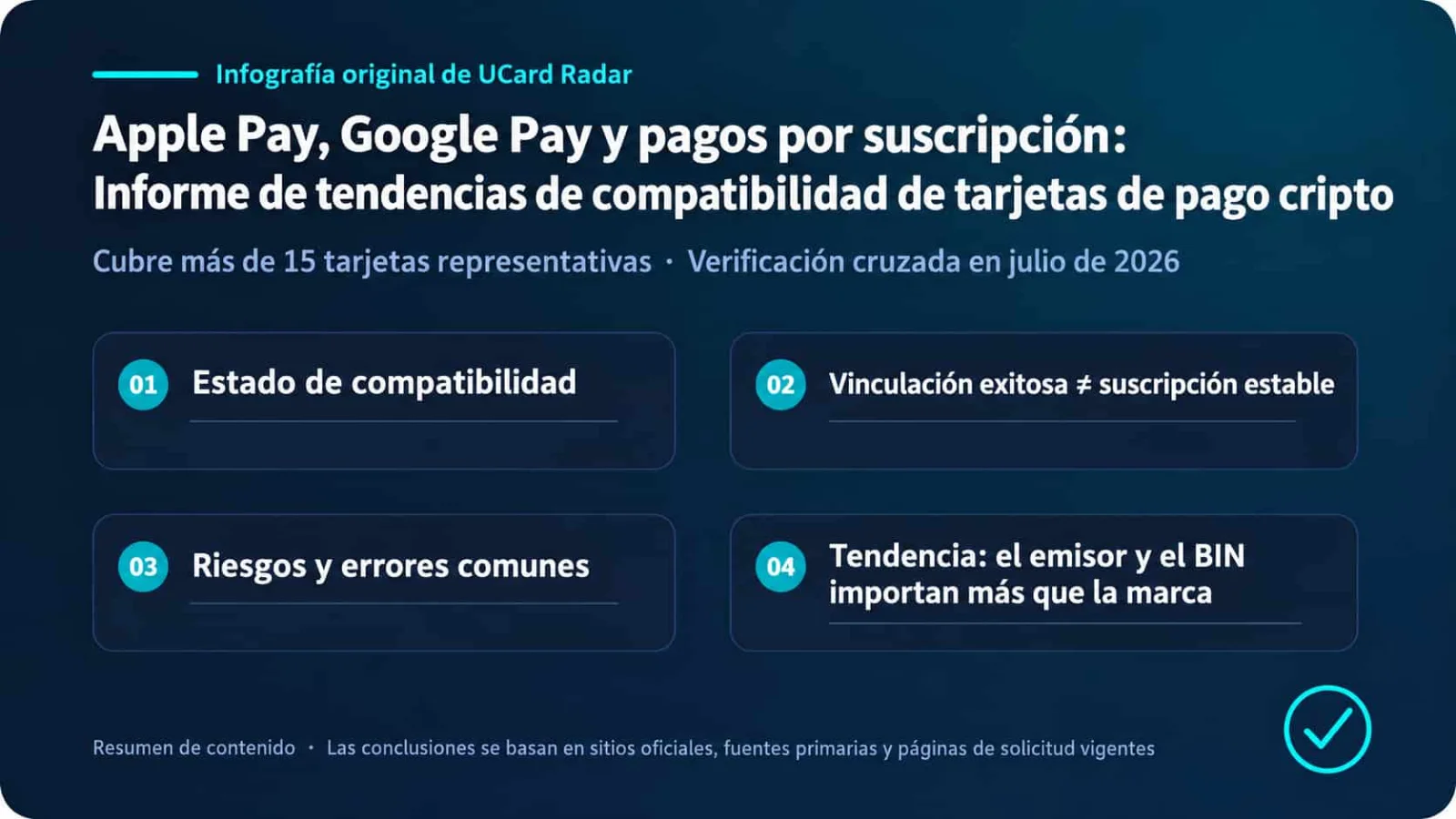
Evidence and limits of the conclusions
Primary verification sources: Set up Apple Pay; Find supported payment methods; Bybit Card.
The verifiable claims in this article concerning crypto-card support for Apple Pay and Google Wallet, including card types, issuing institutions, and regional conditions, are based on the official or regulatory materials cited above. Actual service availability, fees, eligibility criteria, and geographic coverage should be confirmed on the issuer’s or platform’s current application pages.
Results may vary by issuer, region, account tier, and merchant rules. User experience, success rates, fee comparisons, or trend conclusions not directly disclosed by the primary sources above are analytical judgments or inferences and have not been officially confirmed for individual cases by the relevant organizations.
Sample and methodology
Key findings:
Apple Pay depends heavily on the issuer and region. For example, Crypto.com supports it in the United States, the European Union, Australia, Canada, and Singapore, but not in the United Kingdom; Bybit primarily supports it in the EEA and selected other markets. The same brand can behave very differently under different issuers or BINs. Virtual cards can often be added before a physical card arrives, but only where the issuer has integrated with Apple’s tokenization services.
Google Pay has broader overall coverage but is more sensitive to Android-device compatibility, regional settings, and the country attached to the Google account. Some cards support Google Wallet for in-person payments but use a different processing path for subscriptions.
Mobile-wallet compatibility does not equal subscription-payment compatibility. A successful one-time payment does not guarantee stable recurring billing. Subscription success depends more heavily on 3D Secure, AVS billing-address verification, consistency between the issuing BIN country and the subscription country, recurring-payment capability, and merchant anti-fraud controls. Prepaid and virtual cards tend to fail more often with Netflix, Spotify, AI tools such as ChatGPT and Midjourney, and cloud services such as AWS and Google Cloud.
What users in China should watch: 1. Issuing region/BIN, because foreign-issued cards often impose strict address and KYC requirements for Chinese users; 2. recurring billing and AVS support; 3. application and usage differences across mainland China, Hong Kong, Macao, and Taiwan. Applications using mainland Chinese identity are generally more difficult, while Hong Kong and Taiwan tend to be more flexible but are still subject to risk controls. Within the sample, mature options that can be applied for directly using mainland Chinese identity are limited, and many require overseas identity or address support.
The broader trend is that compatibility is shifting from “can this card make a payment?” to “can this card keep making payments reliably?” The issuing partner and compliant BIN increasingly matter more than the consumer-facing brand. Users in China should prioritize products with clearly documented 3DS, AVS, and subscription-payment history, and test recurring billing with small amounts first.
Core findings
Around 65% of the sampled cards explicitly support Apple Pay in supported markets, mainly through Visa/Mastercard issuers. However, a “Visa/Mastercard” label does not itself guarantee Apple Pay support; the specific product and BIN still need to be verified.
Google Pay support is slightly higher, above 70%, but regional fragmentation is significant. For example, Crypto.com UK supports Google Pay while Apple Pay remains unavailable.
Virtual cards are faster to add to mobile wallets than physical cards, but subscription reliability is generally weaker. Merchants may classify them as high-risk or prepaid, which can lead to rejection by AI and cloud-service providers.
Mature crypto-card options available directly to mainland Chinese users remain limited due to KYC and address restrictions. Hong Kong users have access to more local or partner channels, while Taiwan and Macao are somewhat more flexible.
Reliable subscription support depends on recurring billing + complete AVS + a matching BIN. Crypto.com, Coinbase, and similar products perform relatively well for mainstream subscriptions, although BIN changes still need to be monitored.
Self-custodial and regulated issuer-backed cards, such as Gnosis Pay, are becoming more common. Mobile-wallet support is increasingly standard, while prepaid-card subscription approval rates are declining.
Common mistakes include assuming card-network support means full wallet/subscription support, ignoring regional and BIN differences, and confusing one-time payments with automatic renewals.
Cards studied
The sample includes Crypto.com Visa, Coinbase Card, Bybit Card, Wirex, Nexo, Gnosis Pay, Plutus, Uphold, Bitpanda, and active Kraken-related products, excluding cards that have been discontinued or lack sufficient public documentation. Verification was conducted in July 2026, prioritizing official help centers, Apple/Google participating-issuer lists, Visa/Mastercard materials, and official announcements. User reports were used only as supplementary evidence. Support status follows a standardized scale: supported / conditionally supported / indirectly supported / unsupported / unconfirmed. Limitations: some BIN and account-tier details are not public, and actual outcomes may vary due to risk controls.
Crypto card compatibility overview
Card | Card type | Issuing region/institution | Apple Pay | Google Pay | 3D Secure | Recurring billing | Subscription compatibility | Application status for Chinese users | Confidence |
|---|---|---|---|---|---|---|---|---|---|
Crypto.com Visa | Prepaid/debit | US/EU/AU/SG etc. | Supported in multiple regions | Supported in UK/EU etc. | Yes | Yes | Stable support | Difficult in mainland China; conditional in Hong Kong/Taiwan | High |
Prepaid Visa | US/UK/EEA | Supported | Supported | Yes | Yes | Stable support | Difficult in mainland China; US/UK address supported | High | |
Mastercard debit | EEA/BR/AU etc. | Conditional, including EEA | Supported | Yes | Basic | Generally usable | Difficult in mainland China; available in some regions | High | |
Visa/MC | Multiple countries, sometimes via Curve | Conditional/indirect | Supported | Yes | Yes | Generally usable | Limited | Medium | |
Dual-mode Mastercard | EEA/UK | Supported | Supported | Yes | Yes | Stable support | Limited | High | |
Visa debit, self-custodial | EEA/UK/parts of LATAM | Supported | Supported | Yes | Yes | Stable support | Limited | High | |
Visa | UK/EEA | Supported | Supported | Yes | Yes | Generally usable | Limited | Medium | |
Visa debit | US/UK | Supported | Supported | Yes | Yes | Stable support | Limited | High | |
Visa | EEA | Supported | Supported | Yes | Yes | Generally usable | EEA residents | High |
(The table is simplified from public information; the latest official website should be treated as authoritative. Other cards such as Tria and COCA show broadly similar patterns and are not listed individually.)
Current Apple Pay compatibility
Apple Pay support depends heavily on the issuer rather than the card network alone. Crypto.com allows direct addition in supported markets, with virtual cards often available immediately; Coinbase US cards follow a similar model. Restrictions include regional lockouts, such as Crypto.com UK not supporting Apple Pay, BIN-specific rules, and device/Apple ID requirements. Mainland Chinese users using an overseas Apple ID together with a foreign-issued card may encounter risk controls or tokenization restrictions. Virtual cards can often be added first, but replacement cards may require reconfiguration.
Current Google Pay compatibility
Google Pay, now Google Wallet, is more broadly but more unevenly supported. Availability is influenced by device NFC capability, system integrity checks, and the country linked to the Google account. Crypto.com works well with Google Wallet in the UK/EU, while some products differ from Apple Pay by supporting only in-person wallet use. On Android, mismatched regional settings are a recurring practical issue. Users in China should also pay attention to the country attached to their Google account.
Subscription-payment compatibility
Successfully adding a card to a mobile wallet ≠ successful subscriptions; a successful one-time payment ≠ stable automatic renewal. Key factors include recurring-billing capability, 3DS/AVS, consistency between BIN and subscription country, and balance currency.
AI tools such as ChatGPT: Crypto.com and Coinbase tend to be more reliable; prepaid cards are more frequently rejected.
Streaming services such as Netflix and Spotify: most cards work, but a valid billing address is important.
Software/cloud services such as Adobe and AWS: these often require stronger AVS support and a non-prepaid classification; self-custodial products such as Gnosis Pay can perform relatively well.
Apple/Google ecosystems: subscriptions inside the ecosystem are generally smoother once the wallet is set up, but the underlying card still determines whether the transaction succeeds.
The issuing BIN and billing address usually matter more than the brand name.
Compatibility trends
Mobile-wallet support is becoming standard, as seen with Crypto.com and Gnosis Pay.
Issuing partners and BINs matter more than branding; the same brand can behave differently across regions.
Virtual-card issuance is accelerating, but subscription reliability is diverging.
KYC and regional restrictions are becoming stricter.
Prepaid cards are seeing lower approval rates for higher-risk recurring payments.
The market focus is shifting toward stable, continuous payment capability, with tokenization infrastructure increasingly dependent on compliant Visa/MC partners.
Suggested chart data for design: 1. support comparison bar chart, Apple vs Google by card; 2. four-quadrant chart, wallet compatibility × subscription compatibility; 3. impact-factor pie chart; 4. China-region comparison table; 5. timeline of major wallet-integration events from 2024–2026.
Card selection guidance for Chinese users
Mainland China: registration and KYC are difficult, and direct application options are limited. Products such as Crypto.com often require overseas address or other supporting conditions, so subscriptions should be tested first. Hong Kong: generally more flexible, with options such as HashKey-partner cards or Crypto.com. Macao/Taiwan: broadly similar to Hong Kong, but users should pay attention to tax and top-up restrictions.
Apple/Google Pay in-person payments: Crypto.com and Coinbase, where supported.
AI/streaming subscriptions: Nexo and Uphold, where recurring billing is stronger.
Cloud services: compliant self-custodial options such as Gnosis Pay.
Long-term renewals: prefer debit cards or cards with complete AVS support and avoid purely prepaid products. Recommendations should make limitations clear: mainland Chinese users often need overseas supporting conditions, risk-control exposure is higher, and these products are not ideal for frequent high-value payments without a backup method.
Risks and common misconceptions
Visa/Mastercard ≠ wallet/subscription support.
Successful wallet binding ≠ guaranteed in-person NFC success; the device and region still need to match.
One-time payment ≠ automatic renewal; balances and FX can still cause failures.
Merchant rejection may be caused by the BIN rather than the card’s crypto association.
A change of issuer can invalidate previous experience.
Community reports are not universally applicable.
Apple Wallet binding ≠ Apple account top-up.
Google Wallet in-person payment ≠ Google Play payment.
Final conclusion
The most mature combinations today are Visa debit products such as Crypto.com and Coinbase in supported markets, where both mobile-wallet and subscription compatibility are relatively strong. For long-term subscriptions, compliant debit cards with recurring-billing capability and complete AVS support should be prioritized. Self-custodial options such as Gnosis Pay are more suitable for users who prioritize control, while purely virtual or prepaid cards are better treated as backups. Chinese users should first verify issuing region, 3DS/AVS, recurring-billing capability, and current BIN policy. The next stage to monitor is the entry of new issuers under frameworks such as MiCA and Hong Kong regulation, together with changes in BIN stability. Users should test with small amounts and diversify payment risk.