
Crypto payment cards have reached a point where Visa and Mastercard are no longer just two logos in the bottom-right corner of a card.
Whether a card can be applied for, which stablecoins it supports, whether it works with Apple Pay, and whether subscriptions and refunds are supported mainly depend on the brand, wallet platform and actual issuer. But whether that card can access the global merchant network, and how the funds behind it are cleared and settled, still depends heavily on Visa and Mastercard.
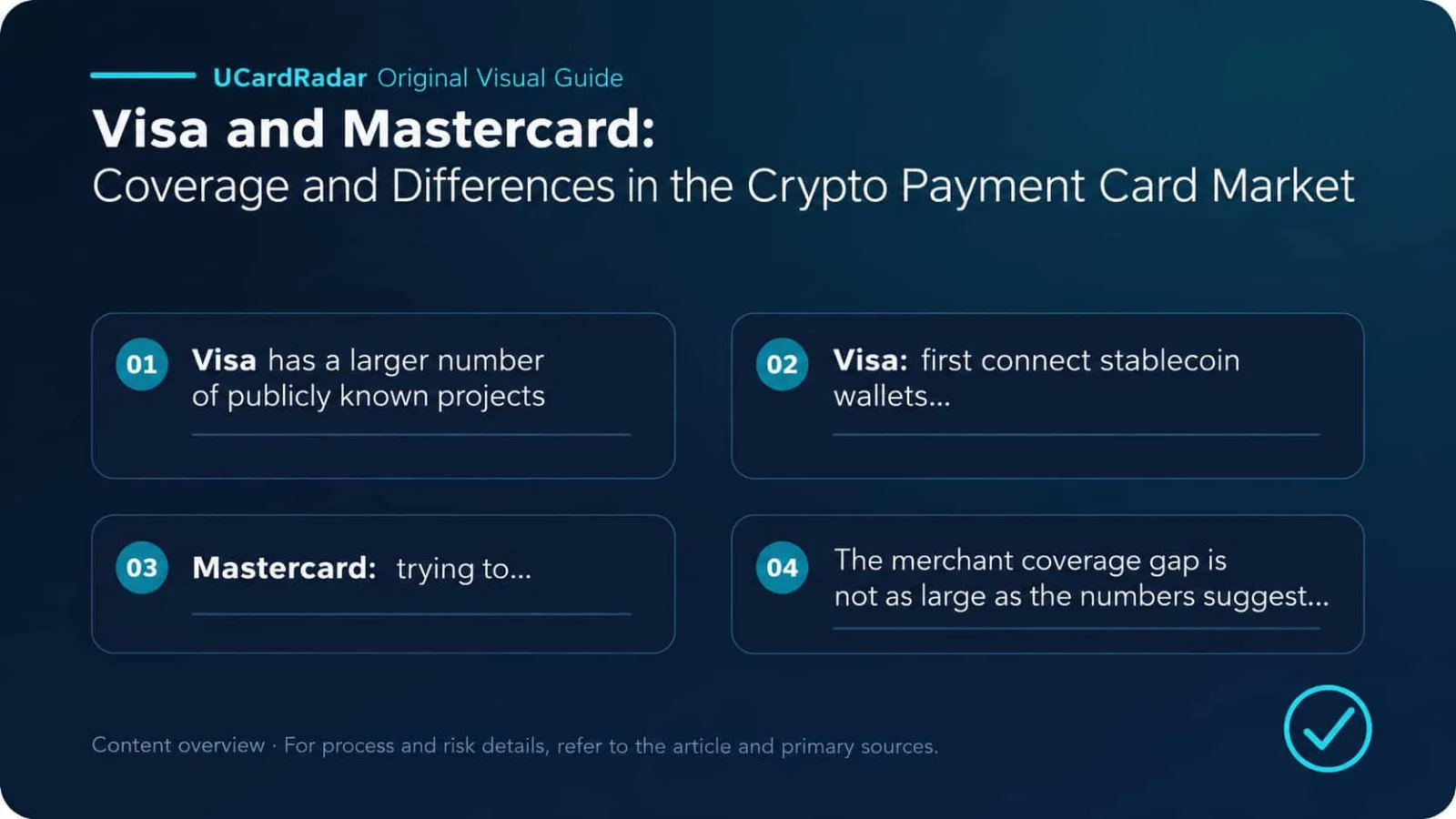
Both companies are expanding their crypto payments businesses, but they are not following exactly the same strategy.
Visa is currently focused on scaling stablecoin card issuance and settlement. Through infrastructure providers such as Bridge, Rain and Baanx, it provides card capabilities to wallets, trading platforms and fintech companies.
Mastercard is also pushing deeper into crypto cards, but its scope is broader. Beyond issuance, its strategy includes buying digital assets, wallet transfers, bank off-ramps, on-chain identity and stablecoin settlement.
In simple terms, Visa currently looks more like an already-deployed stablecoin card issuance network, while Mastercard is trying to cover the entire path from digital assets entering a wallet to their eventual use in everyday spending.
Sources and Boundaries of the Conclusions
Primary-source verification: Visa Core Rules and Visa Product and Service Rules; Mastercard Transaction Processing Rules; SafePal Banking Gateway.
The verifiable facts in this article concerning network rules and the structure of Visa and Mastercard crypto payment card programs are based on the official or regulatory documents listed above. Actual service status, pricing, eligibility and geographic availability should be confirmed on the issuer's or platform's page at the time of application.
Different issuers, jurisdictions, account tiers and merchant rules may produce different outcomes. Any discussion of user experience, success rates, fee comparisons or trends not directly disclosed in the primary sources above should be treated as analysis or inference rather than an officially confirmed conclusion about a particular case.
Visa Has Disclosed a Larger Number of Programs
As of the first half of 2026, Visa had publicly disclosed more than 130 stablecoin-linked card programs across more than 50 countries.
Visa expects that number to increase significantly during 2026 as existing issuers and program managers continue to launch. Over the previous year, around 1.9 million stablecoin-denominated cards on the Visa network were used in transactions, generating approximately $3.7 billion in payment volume.
Mastercard has not published a directly comparable figure equivalent to “130 programs,” so this cannot be used to conclude that Mastercard has fewer crypto cards.
Mastercard more commonly discloses the scale of its partner ecosystem. Its Crypto Partner Program has attracted more than 100 crypto companies, banks, payment institutions and infrastructure providers, including Binance, Bybit, Crypto.com, Gemini, Kraken, MetaMask, MoonPay, OKX, Paxos, Rain, Ripple and Solana.
The two companies report their scale differently.
Visa emphasizes how many card programs have launched, how many countries they cover and how much transaction activity they generate. Mastercard emphasizes how many wallets, exchanges, banks and technology providers it connects. These datasets cannot be directly combined to calculate market share.
Comparison | Visa | Mastercard |
|---|---|---|
Stablecoin card programs | More than 130 disclosed | No directly comparable figure disclosed |
Disclosed geographic coverage | More than 50 countries | No directly comparable figure disclosed |
Publicly stated acceptance footprint | More than 175 million merchant locations | More than 150 million merchant locations |
Issuing focus | Connecting stablecoin wallets and accounts to Visa cards | Wallet, exchange and self-custody card models in parallel |
Stablecoin settlement | Earlier start, with operating scale disclosed | Expanding multi-currency, multi-chain settlement in 2026 |
Business expansion | Issuing, settlement and cross-border money movement | Issuing, on-ramps, off-ramps, transfers, identity and settlement |
These figures are useful for understanding the overall strategic footprint, but they do not prove that any individual Visa card will work better than any individual Mastercard.
For major merchants in most countries, the two networks overlap heavily. In practice, the differences that cause payment failures usually come from the issuing jurisdiction, BIN, card type and risk controls rather than the card network itself.
Visa: Connecting Stablecoin Wallets to Global Merchants First
Visa's strategic direction in recent years has been clear: make it easier for stablecoin wallets to issue payment cards.
These products typically work by allowing users to hold assets such as USDC or USDT in a wallet or platform account. When a purchase is made, the system deducts the required balance, performs any necessary conversion, and then settles the merchant in fiat through the Visa network.
The merchant does not need to know that the customer is using stablecoins, nor does it need to receive assets on-chain. From the merchant's perspective, it is still an ordinary Visa card transaction.
Visa does not operate wallets directly for users and does not custody all underlying assets. It sits between issuers and the merchant network, providing transaction authorization, clearing rules and global acceptance.
To accelerate launches, Visa has begun working more closely with card infrastructure companies.
Bridge is a representative example. It combines stablecoin wallets, issuing partners, card processing and compliance capabilities, allowing wallets and fintech platforms to launch their own Visa cards through standardized interfaces.
Products using this model have already entered multiple markets, and wallets such as Phantom and MetaMask have begun using similar issuing infrastructure. For wallet companies, this is much simpler than separately sourcing a bank, processor and card network.
Rain is more focused on end-to-end enterprise card issuing, covering consumer cards, corporate expense cards, transaction processing and stablecoin settlement. Baanx focuses more heavily on self-custody wallets and Web3 platforms.
These partnerships show that Visa does not appear to want to operate wallets itself. Instead, it wants to become the default card network used when wallets connect to real-world commerce.
Mastercard: Trying to Cover the Entire Movement of Funds
Mastercard's crypto card strategy shares some similarities with Visa. It also supports exchange cards, stablecoin cards and self-custody wallet cards.
The difference is that Mastercard is not focused only on the spending side.
It wants to participate across the full flow: when users buy digital assets, store them in wallets, transfer them to other wallets, spend through cards and eventually move funds back into bank accounts.
Mastercard's crypto business can broadly be divided into several areas:
Buying crypto assets with bank cards;
Providing branded cards for exchanges and wallets;
Converting stablecoin balances into everyday spending;
Moving funds associated with crypto assets into bank accounts;
Providing stablecoin settlement for merchants and financial institutions;
Simplifying wallet addresses and identity verification.
Mastercard Move primarily handles transfers between accounts, cards and wallets. In crypto use cases, it can connect wallet off-ramps, bank accounts and cross-border payments.
Crypto Credential is intended to simplify complex wallet addresses. Instead of copying a long on-chain address every time, users can transfer funds using a verified identifier.
Not all of these capabilities are payment-card products, but together with the card business they form a broader digital-asset payments stack.
Visa is more focused on helping wallets quickly issue cards that can be used globally. Mastercard is more focused on controlling multiple stages of the flow: entry, transfer, spending and exit.
The Merchant Coverage Gap Is Smaller Than the Headline Numbers Suggest
Visa says its network connects more than 175 million merchant acceptance locations, while Mastercard has disclosed more than 150 million.
On paper, Visa's figure is higher. In real-world use, however, the difference is usually much less noticeable than a 25-million-location gap would suggest.
One reason is that the two companies may count differently. Merchants, physical stores, terminals and online acceptance points can fall into different reporting categories.
More importantly, a very large number of merchants accept both Visa and Mastercard. When users pay at chain supermarkets, hotels, airports, online stores and restaurants, the network logo alone rarely creates a significant difference.
Crypto card payment failures are more commonly caused by factors such as:
The merchant does not accept prepaid cards;
The issuer restricts international transactions;
The card does not support 3D Secure;
The available balance is insufficient to cover a pre-authorization;
The merchant blocks BINs from certain countries;
The issuer prohibits gambling, remittance or financial transactions;
The card does not support recurring subscriptions;
The platform's risk controls block an unusual transaction.
Hotel deposits, car rentals, advertising platforms, cloud services and AI subscriptions are especially sensitive to these factors.
These problems generally cannot be reduced to insufficient Visa or Mastercard coverage. Replacing a card with another card on the same network but from a different issuer can produce a completely different result.
Stablecoin Settlement: Visa Entered Production Earlier
When a payment occurs, the cardholder only sees a balance being deducted. What really affects the issuer's cost and capital efficiency is how settlement happens in the background.
Traditional card settlement depends on bank accounts and fiat liquidity. Issuers need to pre-fund settlement and are constrained by banking days, cross-border transfers and differences between national account systems.
Stablecoin settlement allows some institutions to use assets such as USDC to meet settlement obligations directly with the card network.
Visa moved into this model relatively early.
From its initial USDC pilots, to support for Ethereum, Solana, Avalanche and Stellar, and then to additional blockchains, Visa's stablecoin settlement program has moved from proof of concept into live operation.
By 2026, Visa had disclosed an annualized stablecoin settlement run rate of roughly $7 billion. Some partner banks and issuers can also settle on weekends and holidays instead of waiting for traditional banking systems to reopen.
Cardholders may not see any visible interface change, but the model can reduce the time and cost required for issuers to move settlement funds across borders.
Mastercard also expanded stablecoin settlement in 2026, supporting assets including USDC, PYUSD, USDG, USDP, RLUSD and SoFiUSD, while connecting to networks such as Ethereum, Solana, Polygon, Base, Arbitrum and XRPL.
Based on currently disclosed progress, Visa started earlier and has released clearer operating data. Mastercard supports a wider range of stablecoin issuers and places more emphasis on giving institutions a choice between fiat settlement and on-chain settlement.
Visa Leans Toward USDC, While Mastercard Supports a Broader Currency Set
Visa's early stablecoin settlement work centered primarily on USDC.
That is a relatively conservative path. USDC has comparatively mature institutional partnerships, reserve disclosures and banking connectivity, making it a logical settlement asset for a major payment network to test first.
Visa subsequently added more blockchain networks, while keeping its stablecoin lineup relatively concentrated.
Mastercard chose to connect with multiple stablecoin issuers at the same time. In addition to USDC, this includes stablecoins issued or supported by PayPal, Paxos, Ripple and other institutions.
This does not mean Mastercard cardholders can freely choose from a larger number of currencies.
The card network provides the underlying settlement capability. Which assets users can actually fund remains a decision for the wallet, exchange, program manager, issuing bank and local regulators.
A Mastercard may support only USDT, while a Visa card may support USDC, USDT and other assets at the same time. The list of currencies supported at the network level cannot be used to infer the funding options of a specific card.
Self-Custody Cards Have Become a Shared Battleground
Self-custody payment cards have become one of the most closely watched areas of the crypto card market.
Traditional exchange cards require users to transfer assets into a platform account. Self-custody cards attempt to keep funds in the user's own wallet for as long as possible, with spending executed only when a payment occurs through smart-contract authorization or real-time debiting.
Mastercard was an early promoter of this model through MetaMask Card, Baanx and other wallet initiatives.
Users do not need to keep all of their funds on a centralized exchange for extended periods. They can authorize spending from a self-custody wallet and then pay through the Mastercard network.
Visa later entered the same market through Bridge, Baanx and similar platforms. Wallets such as MetaMask and Phantom have also begun to appear with Visa issuing solutions.
It is therefore no longer accurate to say that Mastercard is focused on self-custody while Visa only serves centralized platforms. Both companies are competing for the wallet layer.
The real differences between self-custody cards depend mainly on wallet and smart-account design:
Whether assets always remain in the user's own address;
Whether funds must be preloaded into a separate smart contract;
How much spending authority the user can grant;
Whether authorization can be revoked at any time;
Which chain is used at the time of purchase;
Who pays gas fees;
How smart-contract failures are handled.
The Visa or Mastercard logo on the card does not answer these questions.
It is also important to note that self-custody does not mean no KYC. Users may retain custody of their assets, but card onboarding, sanctions screening and transaction monitoring are still handled by licensed issuers.
For Ordinary Users, the Card Network Should Not Be the First Selection Criterion
When choosing a crypto payment card, many users first ask whether they should choose Visa or Mastercard.
The importance of that question is usually overstated.
For everyday spending, both networks provide sufficiently broad merchant coverage. Compared with the network itself, the following factors deserve higher priority.
Whether You Can Actually Apply
Being allowed to register for a wallet or trading account does not mean the card itself is available in your region.
Before applying, confirm:
Whether residents of your country are accepted;
Whether local identity documents are supported;
Whether proof of address is required;
Whether a physical card can be delivered;
Whether a virtual card is separately available;
Whether renewals will continue to be supported in your region.
“Globally usable” usually means the card can be spent with merchants around the world. It does not mean residents of every country can apply for it.
Who the Actual Issuer Is
Neither Visa nor Mastercard directly operates the user's account.
When an account is frozen, a balance is disputed, a refund fails or a card is disabled, the party ultimately responsible is the issuing bank, electronic money institution or program manager.
If a product emphasizes Visa or Mastercard but does not disclose the actual issuing entity, that is not a strength. It is a warning sign.
Where User Funds Are Held
Custodial products usually require users to deposit stablecoins or other crypto assets into a platform account. This is convenient, but the platform controls the funds.
Self-custody products allow users to retain private keys and on-chain control, but may introduce smart-contract authorization, network fees and technical risks.
Neither model is universally better. The key question is whether the platform clearly explains the path of funds.
What the Total Cost Is
The card network is usually not the main source of crypto card fees.
The user's actual costs may include:
On-chain deposit fees;
Crypto conversion spreads;
Card issuance fees;
Monthly or annual fees;
Foreign exchange fees;
Cross-border transaction fees;
ATM withdrawal fees;
Refund processing costs;
Weekend FX markups.
A card advertised as having “zero spending fees” may still generate substantial revenue through conversion rates and funding fees.
Whether It Works for Subscriptions and Pre-Authorizations
For users who need to pay for ChatGPT, cloud servers, advertising platforms, hotels or car rentals, the payment network alone is not enough.
You also need to confirm:
Whether 3D Secure is supported;
Whether recurring billing is allowed;
Whether pre-authorizations are supported;
Whether delayed settlement can be processed;
Whether refunds return to the original card;
How refunds for earlier transactions are handled after the card is replaced or renewed.
These rules are mainly determined by the issuer and card processing platform.
Whether Apple Pay and Google Pay Are Supported
Mobile wallet support is not determined uniformly by Visa or Mastercard.
Within the same card network, support may differ completely by country, BIN and issuing institution.
The specific product must be verified rather than inferred from the network logo.
For Card Platforms, the Differences Between the Two Networks Are More Material
Ordinary users see the payment experience. Platforms choosing a card network face a much more complex set of considerations.
A platform integrating Visa may place greater value on the maturity of its stablecoin card programs, multi-market issuing experience, standardized infrastructure such as Bridge, and USDC settlement capabilities that are already running in production.
A platform integrating Mastercard may place more weight on Crypto Card Program, Mastercard Move, Crypto Credential and multi-stablecoin, multi-chain settlement options.
Beyond that, platforms also need to consider:
Whether suitable licensed issuers exist locally;
Whether stable BIN capacity is available;
Whether cards can support Apple Pay and Google Pay;
The technical capabilities of the transaction processor;
Fraud and chargeback costs;
Commercial revenue-sharing between the network and issuer;
Regulatory constraints in different markets;
Physical card manufacturing and delivery capability.
It is not unusual for the same brand to use different card networks in different countries.
European users may receive Visa cards, US users may receive Mastercard cards, and Asian markets may be served by a different issuing institution altogether. Even if the cards carry the same brand, the underlying issuing structure can be completely different.
Visa and Mastercard Are Unlikely to Be Easily Bypassed by Stablecoins
When stablecoins first began moving into payments, some in the industry believed blockchain would bypass Visa and Mastercard entirely, allowing users to transfer money directly to merchants without traditional card networks.
That is not how the market has developed.
On-chain payments can reduce some cross-border transfer costs and operate around the clock. But ordinary retail payments still require users and merchants to solve many other problems:
Merchant acceptance;
Currency conversion;
Transaction authorization;
Fraud detection;
Error handling;
Refunds;
Chargebacks;
Consumer protection;
Accounting and tax records.
Visa and Mastercard have spent decades operating these systems.
Stablecoins are better suited to global liquidity and on-chain movement of funds, while card networks continue to manage merchant acceptance and transaction rules. For now, the relationship is not one of replacement, but of division of labor.
Users hold stablecoins, card platforms convert the funds, the card network processes the payment, and the merchant receives fiat. For most consumers, this remains the easiest path today.
Based on publicly disclosed data, Visa currently leads in the number of stablecoin card programs, geographic reach and actual settlement scale.
Through platforms such as Bridge, Rain and Baanx, Visa is making stablecoin issuing capabilities available to a growing number of wallets and fintech companies.
Mastercard's public issuing data is less complete than Visa's, but its strategic scope is broader. Beyond consumer cards, it is building capabilities for on-ramps, off-ramps, wallet transfers, on-chain identity and multi-stablecoin settlement.
For ordinary users, the difference in merchant coverage between Visa and Mastercard is usually not decisive.
Whether a card is worth using long term still depends on whether the issuer is reliable, regional eligibility is clear, custody arrangements are transparent, fees are reasonable, and subscriptions, refunds and dispute handling work properly.
For the industry, the real competition is not simply about issuing more cards.
The network that wins support from more wallets, stablecoin issuers, banks and licensed card issuers will have a stronger chance of controlling the gateway through which crypto assets enter real-world payment networks.
Data cutoff: July 19, 2026